
Table of Contents
Electric truck charging in 2026 is no longer a pilot programme question — it is an operational one. With the global electric truck market projected to grow from $2.13 billion in 2026 to $17.09 billion by 2034 at a CAGR of 29.70%, fleet operators, charge point operators (CPOs), and depot owners face a rapidly narrowing window to build charging infrastructure that will still be viable in three to five years. This article breaks down the five most significant electric truck charging trends shaping infrastructure decisions in 2026 — from the rise of the Megawatt Charging System (MCS) to the role of battery storage in depot energy management — and explains what each trend means for operators specifying charger hardware today.
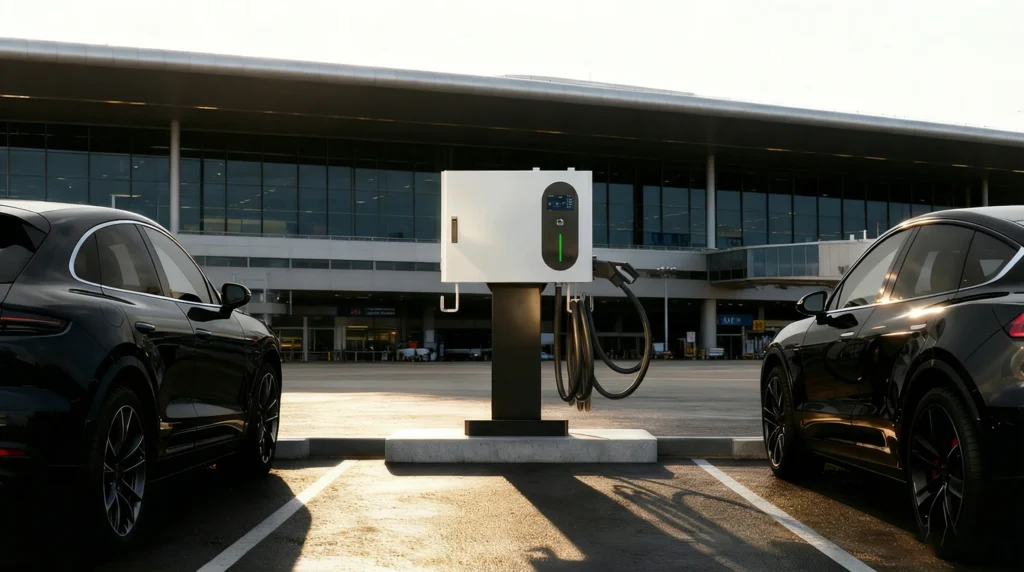
Depot charging with DC fast chargers (150–400 kW) remains the dominant model in 2026. MCS (1 MW+) is entering early corridor deployment but requires significant grid investment. Energy storage integration, OCPP 2.0.1 compliance, and dynamic load balancing are the three infrastructure features that determine whether a depot remains cost-competitive through 2030.
1. The Electric Truck Market Has Reached Inflection Point in 2026
The scale of fleet electrification has accelerated beyond early-adopter territory. Global electric truck deployment exceeded 32,000 units by end-2024 — a 60% increase from 20,000 units in 2022 — with China accounting for the largest regional share at over 18,000 units. In Europe, over 10,000 units were deployed across the continent by 2024, with Germany, France, and the Netherlands leading adoption under stringent CO₂ regulations for heavy-duty vehicles.
For logistics operators, the commercial case is hardening. DHL, UPS, and FedEx have committed to electrifying their delivery fleets with a combined target of 20,000 electric trucks by 2026, and fleet operators are reporting 25–40% reductions in fuel and maintenance costs over comparable diesel operations. In Europe, a comprehensive total-cost-of-ownership analysis published through the ALICE industry body found that battery-electric trucks in dedicated applications — overnight depot charging, fixed-route schedules — are already approaching cost parity with diesel without subsidies.
This scale of adoption has a direct consequence for charging infrastructure: the number of trucks requiring simultaneous depot charging is rising faster than many site operators had planned for. Understanding the correct charging architecture for each use case is now a procurement-critical decision.
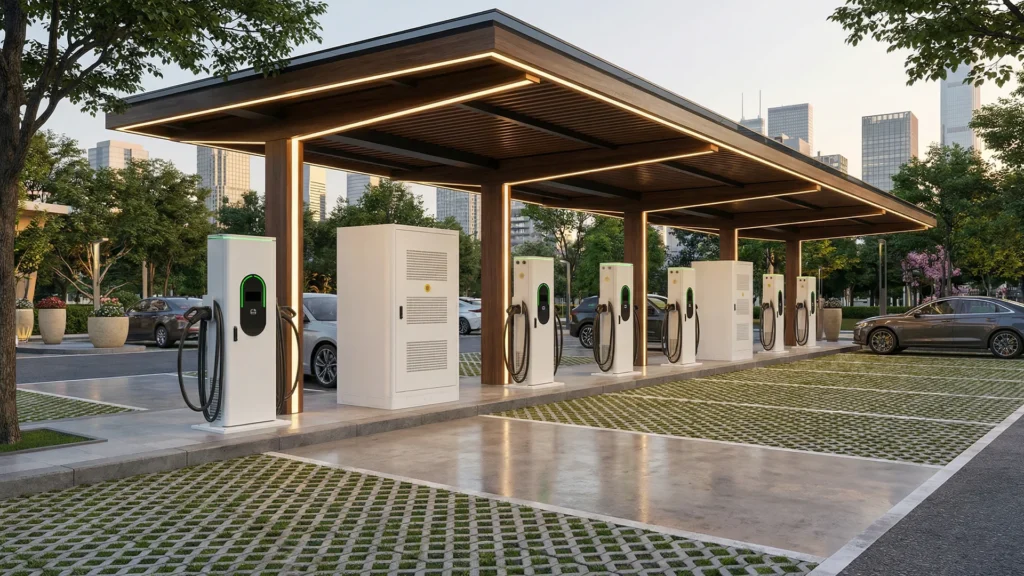
2. Megawatt Charging System (MCS): What It Is and Where It Actually Makes Sense
The Megawatt Charging System (MCS) is a DC charging standard developed by CharIN and formalised under IEC TS 63379 and SAE J3271. It is engineered specifically for Class 6, 7, and 8 commercial vehicles with battery capacities exceeding 400 kWh. Unlike the current CCS2 standard, which delivers up to 350–500 kW, MCS is capable of delivering charging capacity up to 3.75 MW — seven times higher than the current light-duty fast charging peak of 500 kW.
In practical fleet terms, MCS closes the operational gap between electric and diesel trucks. A Class 8 truck with a 600+ kWh battery requires 1–2 hours on a conventional dual-gun 300 kW DC fast charger. MCS enables a truck battery to reach 80% charge within a standard EU driver rest break of 45 minutes, making long-haul electric operation commercially viable on the same scheduling terms as diesel.
However, MCS is not the right solution for every fleet depot in 2026. Key implementation constraints include:
- Grid connection requirements: MW-class chargers behave like industrial loads. Most sites require significant civil engineering, switchgear upgrades, and utility coordination — a process that can take 12–36 months depending on jurisdiction.
- Vehicle availability: MCS-capable trucks are entering volume production in 2026. Scania’s first MCS-capable electric trucks became commercially available in early 2026, with initial connector configurations delivering up to 750 kW. Fleet operators deploying MCS infrastructure ahead of MCS-capable vehicles need to plan for a transition period.
- TCO implications of energy procurement: 73% of fleet operators in 2025 identified energy procurement costs — not charging speed — as their primary operational concern. Grid upgrade costs that increase per-kWh prices can neutralise the uptime benefits of MCS for many operators.
The practical 2026 guidance: MCS makes sense for high-throughput corridor hubs, drayage yards with fast turnaround requirements, and logistics centres with 20+ daily truck departures on fixed long-haul routes. For regional distribution, urban delivery, or overnight depot charging, DC fast chargers in the 150–400 kW range remain more cost-effective and simpler to deploy.
What Is the Difference Between CCS2 and MCS for Electric Trucks?
CCS2 (Combined Charging System 2) is the current international standard for DC fast charging of commercial electric vehicles, supporting up to 350–500 kW. MCS (Megawatt Charging System) is the next-generation heavy-duty standard, engineered to deliver 1,000 kW to 3,750 kW — designed specifically for trucks, buses, and off-highway equipment with large battery packs. Both standards use different connector designs: MCS connectors are liquid-cooled to handle the high current loads. For fleet operators, CCS2 covers the majority of depot and regional charging use cases in 2026, while MCS addresses long-haul corridor and high-throughput yard applications where 30-minute charging windows are operationally necessary.
| Feature | CCS2 (Current Standard) | MCS (Next-Generation) |
|---|---|---|
| Max power output | Up to 500 kW | 1,000 kW – 3,750 kW |
| Charge time (600 kWh truck) | 60–120 minutes (to 80%) | 20–45 minutes (to 80%) |
| Vehicle compatibility (2026) | All current electric trucks | Scania (2026), Windrose, Tesla Semi, others in pipeline |
| Grid infrastructure | Standard commercial/industrial | Medium-voltage industrial (significant upgrades required) |
| Best use case | Depot overnight, regional distribution | Corridor hubs, high-throughput drayage yards |
| OCPP compatibility | OCPP 1.6 / OCPP 2.0.1 | OCPP 2.0.1 / ISO 15118-20 |
| Deployment readiness | Mature — available now | Early deployment — corridor pilots 2025–2026 |
3. Depot Charging Architecture: Dynamic Load Balancing Is Now Non-Negotiable
For most fleet operators in 2026, the primary charging infrastructure challenge is not speed — it is cost-efficient power management across multiple simultaneous sessions at a single depot. A depot supporting 20–50 electric trucks requires careful management of peak demand charges, grid connection capacity, and vehicle dwell times. Without dynamic load balancing (DLB), operators frequently trigger costly demand tariff penalties or install oversized grid connections that remain underutilised.
DLB works by distributing available site power intelligently across connected vehicles based on real-time grid conditions, vehicle state-of-charge, and departure schedules. 70% of new charging installations in 2025 utilised dynamic power allocation to manage peak demand charges and reduce grid stress — a figure that reflects how central load management has become to depot charging ROI.
Modern DLB implementations integrate with fleet management software through OCPP 2.0.1 to receive vehicle departure schedules and prioritise charging accordingly. Trucks departing earliest receive priority power allocation; vehicles with longer dwell times charge at reduced rates during off-peak windows. This approach allows operators to maximise throughput without upgrading their grid connection capacity.
DC fast chargers in the 150–400 kW range with built-in DLB support are the standard specification for commercial fleet depots deploying at scale in 2026. When evaluating charger hardware, fleet operators and CPOs should verify OCPP 2.0.1 compliance, power-sharing capability across multi-unit installations, and compatibility with existing fleet management backend systems.
4. Energy Storage Integration: The Grid Constraint Workaround
Grid connection limitations are emerging as one of the most significant deployment bottlenecks for electric truck charging infrastructure globally. Upgrading a utility connection to support high-power depot charging can take 12–36 months and cost hundreds of thousands of dollars in civil and electrical engineering. For operators who cannot wait — or cannot afford — a grid upgrade, behind-the-meter battery energy storage systems (BESS) are an increasingly viable alternative.
A BESS charges from the grid during off-peak hours at lower tariff rates, then discharges to support peak charging demand during operational hours. This approach allows a depot to deploy DC fast chargers at higher aggregate power than the grid connection would otherwise permit, while also reducing demand charge exposure. When combined with on-site solar generation, a BESS enables the Generation-Storage-Charging (GSC) integrated model — increasingly recognised as the most resilient and cost-efficient architecture for large-scale truck charging operations.
AI-driven energy management systems are becoming a foundational tool for 2026 EV charging operations, coordinating energy from grid supply, on-site generation, and battery storage to minimise operating costs while maintaining vehicle uptime targets. These systems use predictive load models based on fleet schedules to optimise charge/discharge cycles and avoid peak tariff windows.
For fleet operators evaluating charging infrastructure, CE-certified energy storage systems integrated with EV charging provide a deployable solution that addresses grid constraints without multi-year utility upgrade timelines. BESS-integrated charging is now a standard design consideration for depots handling 10 or more heavy-duty vehicles.
5. OCPP 2.0.1 and Backend Interoperability: The Software Layer That Determines Operational Scalability
Charging hardware is only as useful as the software layer managing it. For CPOs and fleet operators deploying at multiple sites or integrating with third-party fleet management systems, OCPP (Open Charge Point Protocol) compliance determines whether a charging installation can scale operationally — or becomes a siloed, manually managed problem.
OCPP 1.6 has been the dominant commercial charging protocol for the past several years, and most deployed infrastructure globally still runs on it. OCPP 2.0.1 introduces several capabilities that are directly relevant to truck fleet operations:
- Smart charging profiles: More granular control over charging schedules per individual vehicle, enabling precise integration with fleet departure schedules.
- Device management: Remote diagnostics, firmware updates, and fault monitoring without physical site visits — essential for multi-site CPO operations.
- Transaction event reporting: Richer session data for billing reconciliation, energy accounting, and carbon reporting requirements.
- ISO 15118 Plug & Charge support: Enables automatic vehicle authentication and session initiation without driver interaction — reducing friction in high-throughput depots.
When procuring charger hardware, fleet operators and CPOs should confirm both OCPP 1.6 and OCPP 2.0.1 compatibility. This dual-version support ensures backward compatibility with existing backend management systems while enabling migration to OCPP 2.0.1 features as fleet management platforms upgrade their support. Joint Tech’s DC fast charger product range supports both OCPP 1.6 and OCPP 2.0, providing flexibility for operators at different stages of infrastructure maturity.
Regional Market Snapshot: Where Electric Truck Charging Infrastructure Is Growing Fastest
Infrastructure deployment is not uniform globally. Fleet operators and distributors evaluating market entry or expansion should consider the following regional dynamics in 2026:
- China: The largest electric truck market, with over 18,000 units deployed and aggressive government support including purchase subsidies and zero-emission zone mandates. Charging infrastructure is expanding rapidly in logistics hubs and industrial zones.
- Europe: The EU had established 1,500 electric truck charging stations by 2024, with expansion to 4,000 planned by 2026. AFIR (Alternative Fuels Infrastructure Regulation) mandates public charging deployment along the TEN-T core network. The European electric trucks market is forecast to grow from $4.4 billion in 2026 to $14.7 billion by 2035. Several EU countries offer incentives covering up to 60% of the cost differential between electric and diesel trucks.
- North America: Despite shifts in federal incentive policy in 2025, MCS corridor deployment is progressing through private investment. California remains the leading market, with logistics operators building shared depot networks near seaports and freight corridors. The US electric truck market is projected to reach $0.35 billion by 2026.
- Southeast Asia: Emerging market with growing government interest in commercial fleet electrification, particularly for urban logistics and municipal vehicles. Infrastructure development is in early stages, presenting OEM and distributor opportunities.
Key Takeaways for Fleet Operators and CPOs Specifying Charging Infrastructure in 2026
- DC fast chargers (150–400 kW, CCS2) remain the correct specification for depot and regional distribution charging in 2026. Do not over-specify MCS for use cases where overnight or between-shift charging is viable.
- MCS is the right infrastructure investment for high-throughput corridor hubs and drayage yards with 30-minute turnaround requirements — but grid readiness must be assessed before hardware procurement.
- Dynamic load balancing is a mandatory feature for any multi-unit depot installation. Chargers without DLB support will create demand charge exposure that compromises site ROI.
- Battery energy storage integration should be evaluated for any depot where grid connection upgrade timelines exceed 12 months or where demand tariff exposure is significant.
- Specify OCPP 2.0.1-compatible hardware to future-proof backend integration, even if current management systems only support OCPP 1.6.
- Certifications matter for public-facing or multi-market deployments: CE (Europe), ETL/UL (North America), and CB (international) certification are the baseline requirements for commercial installation.
Joint Tech has deployed approximately 200,000 charging units across 60+ countries since 2015, with a DC fast charger range spanning 30 kW to 400 kW and certified to CE, ETL, CB, TUV, and UKCA standards. For fleet depot and CPO applications, our DC fast chargers 30–400 kW support OCPP 1.6 and OCPP 2.0, dynamic load balancing, and backend integration with major fleet management systems. For North American CCS1/NACS deployments, our CCS1/NACS DC fast chargers for USA & Canada are available with ETL certification. For depots requiring grid constraint management, our CE-certified energy storage systems with EV charging provide integrated BESS solutions for commercial fleet applications.
Contact Joint Tech to discuss your fleet depot charging specification, connector standard requirements, or OEM/ODM partnership enquiry.
